

Office Dilapidations: Leaving Your Lease The Right Way
Office dilapidations is the bill a landlord can claim when you leave a lease with the space in worse shape than the lease allows. This guide explains how it works, the timings that apply, and how to plan the clear-out and handback alongside your move.
The basics
What Dilapidations Mean When You Leave An Office
A commercial lease is a contract about the building as much as the rent. Most office leases say you must keep the space in repair, redecorate at the end, and remove anything you added. If you leave without doing that, the landlord can claim. That claim is called office dilapidations.
Claims can be large, and they often land months after you have moved and spent your budget. The good news is that most of the risk can be managed, if you start early and plan the physical work alongside the move.
I'm Darrin, and I run CMR Relocation from Broadheath in Altrincham. Our team has cleared and moved offices across Manchester and Cheshire since 2011, often in the last weeks of a lease. This guide explains the process and the timings, with links to the official sources. It is not legal or surveying advice. Your solicitor and a building surveyor should advise on your lease.

Read the lease
Repair, Reinstatement And Yield-Up Clauses To Find First
Find these clauses and copy them onto one page. Every later decision depends on them.
- Repair. Must you keep the space in good repair, or only in the state shown in a schedule of condition?
- Decoration. Must you redecorate in the last year of the lease, and to what standard?
- Reinstatement. Must you remove partitions, data cabling, signs and other changes you made?
- Licences for alterations. Did you get consent for works, and did it say they must be removed at the end?
- Yield-up. How must the space be handed back: empty, clean, with all keys?
- Break clause. If you are leaving early, what conditions must you meet? Some require vacant possession.
- Schedule of condition. Is there a photo record from the start? Find it now.
The answers decide how much work there is to do and who should do it. They also decide your timeline. Our six-month planning checklist puts the lease review first for this reason.
Dates and stages
The Dilapidations Timeline From Break Notice To Handback
The protocol timings are guidance from the courts. Your lease and your advisers set the rest.
| When | What usually happens | Who leads |
|---|---|---|
| 12 to 18 months before lease end | Read the lease; appoint a surveyor; decide whether to stay, break or leave | Directors and solicitor |
| Before break notice | Check every break condition, including any vacant possession term | Solicitor |
| 6 to 12 months before | Landlord may serve an interim schedule; agree what work you will do | Surveyor |
| 3 to 6 months before | Book contractors for strip-out and repairs; book the move and clear-out | Move lead |
| Final weeks | Move out, clear, strip out, repair, clean, photograph | Contractors and removal firm |
| Lease end | Hand back keys; keep records of the condition | Move lead |
| Generally within 56 days after | Landlord sends terminal schedule, then a quantified demand | Landlord's surveyor |
| Usually within 56 days of the demand | Tenant responds item by item | Your surveyor |
| Generally within 28 days of response | Both sides meet to narrow the dispute | Both surveyors |
The last three rows come from the Dilapidations Protocol on the Ministry of Justice website. It applies to claims for commercial property in England and Wales at the end of a tenancy. Courts can take account of whether each side followed it when they decide who pays costs.
Surveyors also follow the RICS professional standard Dilapidations in England and Wales (7th edition, reissued as a professional standard in December 2023). If you appoint an RICS surveyor, they will work to it.
The legal cap
Section 18: Why A Claim Cannot Exceed The Loss In Value
A landlord's claim is not simply the cost of every item on the schedule. Section 18 of the Landlord and Tenant Act 1927 caps damages for breach of a repair covenant at the drop in value of the landlord's interest. It also says nothing is due for repairs that would be made worthless because the building will be pulled down or heavily altered soon after the lease ends.
Under the protocol, a landlord who has not done all the work must back its loss with a formal valuation before going to court. This is where a good surveyor earns their fee. Bring one in early, give them the lease and every photo you have, and let them handle the claim.
Physical work
Strip-Out, Cabling And Partition Removal: Planning The Work
Reinstatement work is often the biggest part of office reinstatement works: taking out partitions, raised floors, kitchens, signs and the data cabling you added. This is building work. It needs a strip-out or fit-out contractor, and often a surveyor to set the scope.
The order matters. The furniture and IT must be out before the strip-out crew starts, and the strip-out must finish before repairs and decoration. Work back from the handback date and give each stage enough time.
Before any work that disturbs walls, ceilings or floors, check the asbestos position. Under HSE rules, a refurbishment and demolition survey is needed before that kind of work. See the HSE guidance on asbestos surveys and ask the landlord for the building's asbestos register.
Data cabling often has to come out under the reinstatement clause. Agree with your IT team which kit moves to the new office and which can go, before the cables are cut. Our IT relocation team disconnects and moves the equipment you keep.

Our part
Clearing Furniture And IT Responsibly Before Handback
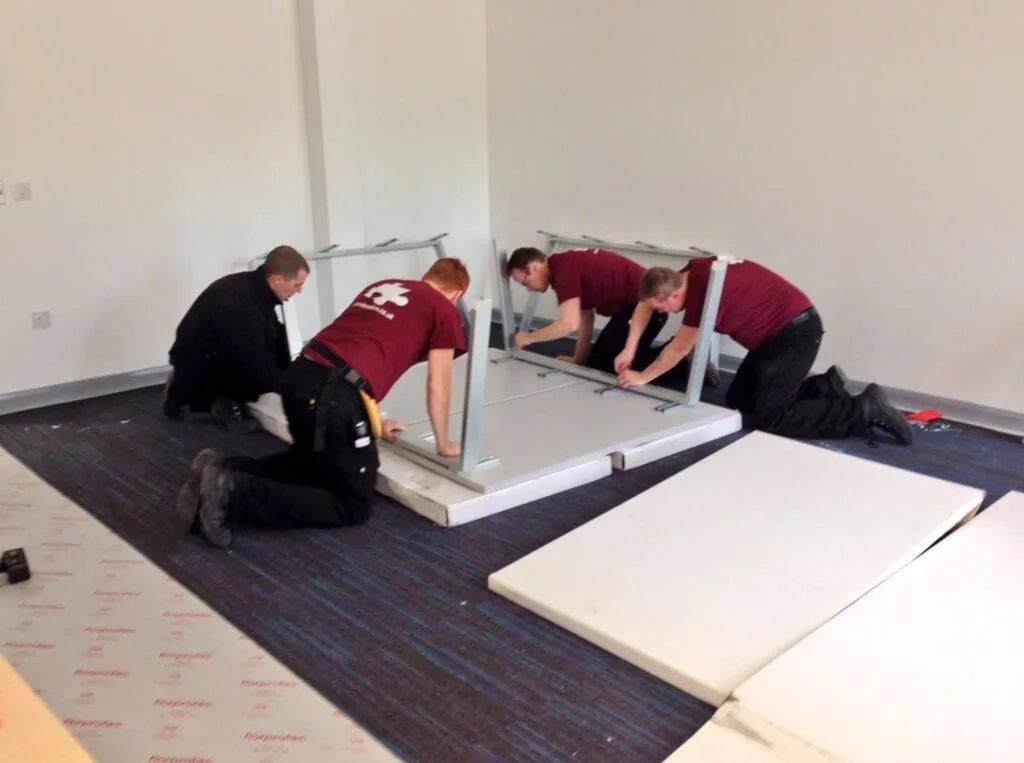
This is the part we do. Our crew dismantles desks, storage and meeting tables, moves what you keep, and clears what you do not. We offer good furniture to local charities and schools first. What is left is broken into metal, wood and laminate for recycling. Retired IT goes through a WEEE-compliant route.
Our office clearance and recycling service covers the clear-out. Our furniture dismantling and fitting team handles the desks, and our office removals service takes the rest to your new address. If the new office is not ready, items can wait in containerised storage at our Broadheath depot.
Book the clear-out early so it finishes before the strip-out crew arrives. Crates for files and IT arrive at least ten days before the move. See our crate hire for office moves. Our guide to the waste rules behind an office clear-out covers the paperwork.
The last day
Photographs, Schedules And Keys On The Last Day
The last day is about evidence. Walk every room with your end of lease office checklist and a camera. Take dated photos of every wall, floor, ceiling and window. Video works well for a fast walk-through.
- Every room empty, including cupboards and the comms room
- Rubbish, cables and signs removed
- Agreed repairs and decoration finished
- Meter readings taken and photographed
- All keys, fobs and access cards counted and handed back, with a signed receipt
Compare your photos with the schedule of condition from the start of the lease. Keep both with your lease file. If a claim arrives, your surveyor will need them.

Get advice early
Getting A Surveyor Or Solicitor Involved Before Notice
The most costly mistakes happen before anyone picks up a screwdriver. A missed break condition or a poor reading of the reinstatement clause can cost more than all the repair work. A building surveyor reads the lease, inspects the space and tells you what work is really needed. A solicitor checks the break notice and any deal you make with the landlord.
Sometimes the best answer is a cash settlement instead of doing the work. Your advisers can tell you if that makes sense. Either way, tell your removal firm the handback date early, so the move and clear-out fit around everything else.
For a sense of how a full office project runs, see our office move case studies. We are open Monday to Saturday, 8:30am to 5:30pm. Call Darrin on 0161 478 3639 or email Darrin.
Leaving an office lease? Tell us your handback date and we will plan the move and clear-out around it.
Get a free quoteFAQs
Office Dilapidations: Questions Tenants Ask
Still unsure about something in this guide? Darrin is happy to talk it through.
What are office dilapidations?
They are breaches of the repair, decoration and reinstatement terms in a commercial lease. When you leave, the landlord can claim for the cost of putting those breaches right, or for the loss in value they cause. The claim is usually set out in a document called a schedule of dilapidations.
When will the landlord send the schedule?
The Dilapidations Protocol says a terminal schedule should be sent within a reasonable time, generally within 56 days after the tenancy ends. Landlords often serve an interim schedule before the lease ends too, so the tenant can do the work itself.
How long do we have to respond to a dilapidations claim?
Under the protocol, the tenant should usually respond within 56 days after the landlord sends its quantified demand. The two sides, or their surveyors, should generally meet within 28 days after the tenant's response. Your surveyor or solicitor will manage these dates.
Can the landlord claim more than the loss in value?
Section 18 of the Landlord and Tenant Act 1927 caps damages for breach of a repair covenant at the amount the landlord's interest has dropped in value. Nothing is due for repairs that would be wasted because the building is to be pulled down or heavily altered soon after. Ask a surveyor how this applies to you.
Does leaving furniture behind matter?
It can. Items left behind may be a breach of the lease, and the landlord may claim the cost of removal. If your break clause requires vacant possession, leaving things behind can put the break itself at risk. Clear the space fully before the handback date.
Does CMR Relocation do strip-out or making-good works?
We clear offices, dismantle and move furniture, and handle IT moves and WEEE-compliant disposal. For removing partitions, ceilings or cabling, and for repairs and redecoration, use a specialist strip-out or fit-out contractor. Ask us and we will plan our part around theirs.
Local area data
Compare towns across Greater Manchester and Cheshire
Thinking about where to move? Tap a town for its prices, schools, crime and commute.
Contains public sector information licensed under the Open Government Licence v3.0, including HM Land Registry data © Crown copyright and database right 2026. Data sources and notes
Prefer a list? Show all 48 towns
Manchester
Rochdale
Cheshire East
Cheshire West and Chester
Warrington
Not on the list?
Your town may still be close by. Call 0161 478 3639 to ask about your town.
Not on the list?
Your town may still be close by. Call 0161 478 3639 to ask about your town.
Not on the list?
Your town may still be close by. Call 0161 478 3639 to ask about your town.